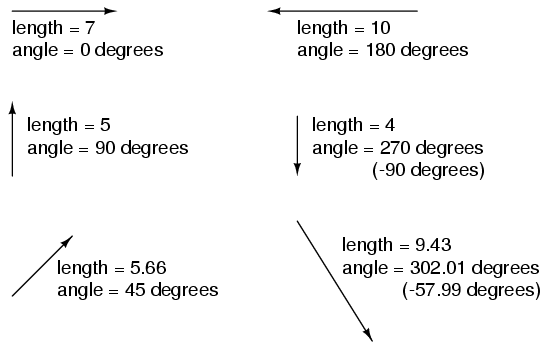
Complex Numbers & Vectors The distance between two cities could be described as a single number in miles, kilometers, or some other unit of linear measurement. However, when describing how to travel from one city to another, more information is needed than just the distance between those two cities. The direction to travel is required as well. Scalar Numbers The kind of information that expresses a single dimension, such as linear distance, is called a scalar quantity in mathematics. Scalar numbers are the kind of numbers you've used in most all of your mathematical applications so far: a one-dimensional quantity like temperature, length, weight, etc. The voltage produced by a battery, for example, is a scalar quantity. So is the resistance of a piece of wire (ohms), or the current through it (amps). However, when we begin to analyze alternating current circuits, we find that quantities of voltage, current, and even resistance (called impedance in AC) are not the familiar one-dimensional quantities we're used to measuring in DC circuits. Rather, these quantities, because they're dynamic (alternating in direction and amplitude), possess other dimensions that must be taken into account. Frequency and phase shift are two of these dimensions that come into play. Even with relatively simple AC circuits, where we're only dealing with a single frequency, we still have the dimension of phase shift to contend with in addition to the amplitude. Complex Numbers In order to successfully analyze AC circuits, we need to work with mathematical objects and techniques capable of representing these multi-dimensional quantities. Here is where we need to abandon scalar numbers for something better suited: complex numbers. Just like the example of giving directions from one city to another, AC quantities in a single-frequency circuit have both amplitude (analogy: distance) and phase shift (analogy: direction). A complex number is a single mathematical quantity able to express these two dimensions of amplitude and phase shift at once. Complex numbers are sometimes easier to grasp when they're represented graphically. A line with a certain length (magnitude) and angle (direction) is a graphic representation of a complex number which is commonly known in physics as a vector:
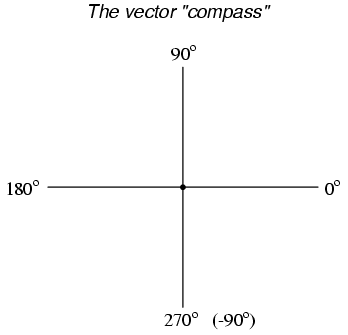
Vectors Unlike a scalar quantity, which is only magnitude, a vector has both magnitude and direction. Like distances and directions on a map, there must be some common frame of reference for angle figures to have any meaning. In this case, directly right is considered to be 0o, and angles are counted in a positive direction going counter-clockwise.
Phasors
The AC voltage or AC current at any
instant in time can be represented by a vector. But, the
AC voltages and currents are constantly changing, so a
rotating vector, or phasor must be used. It
rotates counter-clockwise at a constant angular velocity, ω, in
radians/second. At any instant in time, the magnitude and
phase angle of the voltage or current can be described by a
complex number representing the stopped phasor at that
instant.
|